Initial guidance
Key points
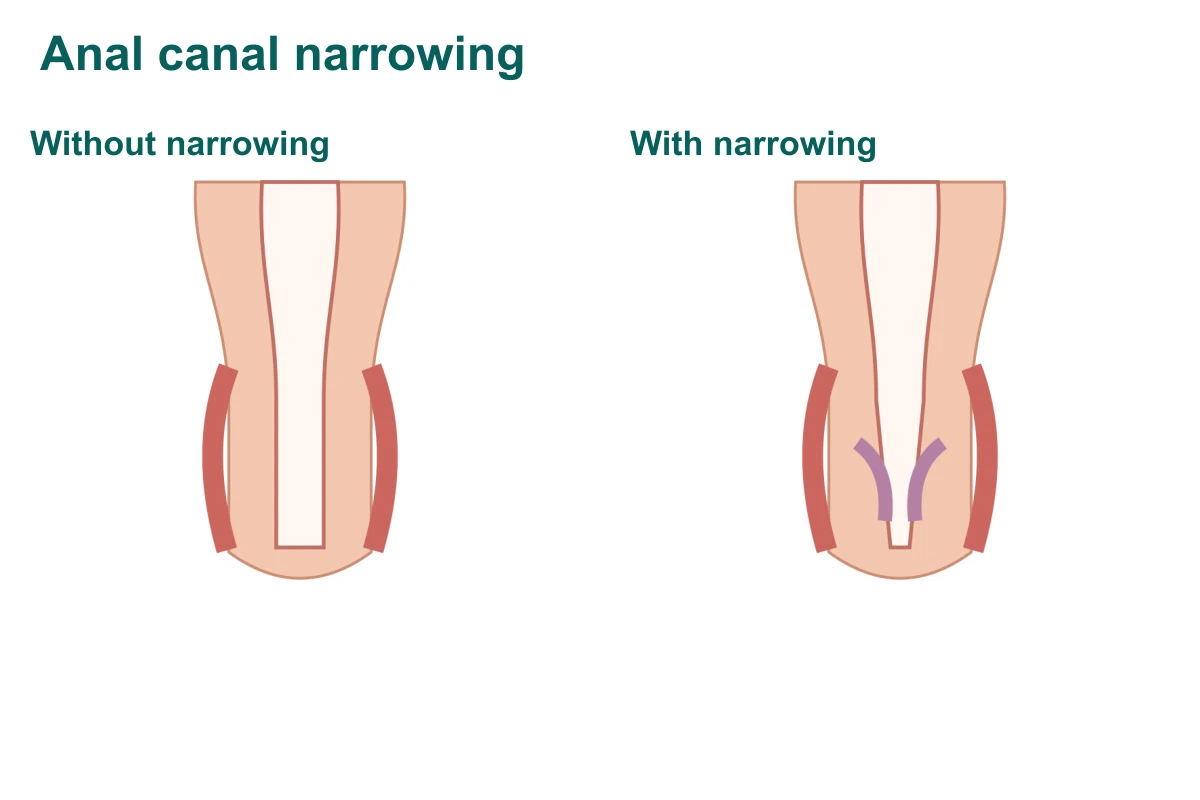
Anal stenosis is narrowing of the anal canal. It may cause difficult or painful bowel movements, bleeding, incomplete emptying and thinner stools. Mild cases may respond to measures that ease stool passage; moderate or severe rigid scarring may require surgical correction. Examination establishes which situation applies.
Why does the anal canal narrow?
Acquired anal stenosis most often results from scarring after anorectal surgery, particularly loss of too much flexible anal canal skin. It can also occur with Crohn's disease, radiotherapy, trauma and other inflammatory processes.
There is an important distinction between anatomical narrowing from inflexible scar tissue and functional difficulty relaxing or opening the outlet. Two people may describe similar obstruction but need different treatments.
Symptoms often occur during bowel movements
Symptoms include increasing effort, painful bowel movements, bleeding, constipation, incomplete emptying or thinner stools. Onset after anal surgery is a particularly relevant clue.
Stool shape or difficult bowel movements alone cannot confirm stenosis. Fissures, inflammation and functional evacuation disorders can cause similar symptoms and change the treatment strategy.
Examination identifies scarring and its extent
Colorectal assessment examines canal diameter, tissue elasticity and the location and extent of narrowing. It also looks for associated lesions and distinguishes fixed scarring from other evacuation problems.
This avoids treating only constipation when anatomical obstruction is present, or proposing surgery when another approach may work.
Are there noninvasive treatments for anal stenosis?
Yes, particularly for mild stenosis. Soft, regular stools through adequate fiber, fluids and constipation management can reduce straining and ease passage. A specialist may also prescribe gradual dilation for some patients.
Do not improvise dilation yourself. Its role depends on stenosis type and severity, and poor technique can injure the canal. First confirm true narrowing and establish appropriate treatment.
Rigid scarring may require surgery to widen the canal
For moderate or severe anatomical stenosis, conservative measures may be insufficient because scar tissue has lost elasticity. Reconstructive techniques, including forms of anoplasty or tissue advancement, aim to widen the canal and introduce more flexible tissue.
No single operation suits every stenosis. Level, extent and severity determine the appropriate reconstruction. A systematic review of anoplasty found differences between techniques and called for better comparative studies before identifying a superior approach for all cases.
For persistent symptoms, identify what is obstructing bowel movements
Increasing straining, painful or bleeding bowel movements, narrowing after anal surgery, or constipation treatment that does not relieve obstruction warrants colorectal assessment for stenosis and its severity.
Dr. Eduardo Navarro can assess whether symptoms arise from anal scarring, a fissure, a functional problem or another cause, then guide conservative treatment or investigation of reconstructive options.
Clinical sources
Clinical sources consulted
This guide draws on information from medical and public health institutions to help you understand the topic.
- Clinical sourceDiagnosis and Management of Anal Stenosis — Diseases of the Colon & Rectum (2025)View source
- Systematic reviewanoplasty for anatomical anal stenosisView source
- Clinical sourceClinical review of narrowing disorders of the gastrointestinal tract (2026)View source
- Hospital General de MéxicoColorectal Surgery Service: 2026 manualView source
This content is informational and does not replace a medical assessment.