
Less abdominal opening
A camera and instruments pass through small incisions to perform surgery inside the abdomen.
Minimally invasive colon and rectal surgery to support a smoother recovery
Dr. Eduardo Navarro performs laparoscopic colorectal surgery through small incisions. In selected operations, this approach may reduce postoperative pain and hospital stay compared with open surgery.
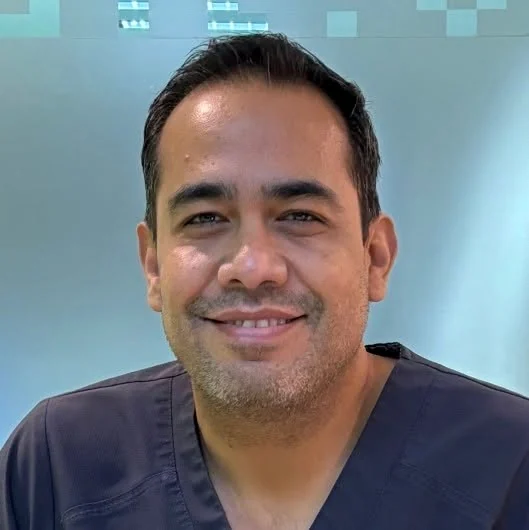
Dr. Eduardo Navarro LaraColorectal surgeon · Laparoscopic colorectal surgery
Minimally invasive surgery
The surgeon introduces a camera and instruments through small openings to see, free and remove the segment needing treatment.
Intended benefits
When an operation is suitable for laparoscopy, minimally invasive access offers postoperative advantages over open surgery without reducing the treatment the colon or rectum needs.
A camera and instruments pass through small incisions to perform surgery inside the abdomen.
Compared with open surgery, laparoscopy may reduce pain and ease initial recovery.
For suitable operations, bowel function may return sooner and hospital stay may be shorter.
Small incisions reduce surgical wound size, although all surgery retains risks and aftercare needs.
These benefits are possible, not universal. Recovery depends on the operation, diagnosis, general health and findings.
Colorectal surgery
The technique is used for different benign and cancer operations when it allows safe completion of the required treatment.
Minimally invasive surgery is an option when disease extent and the cancer treatment plan permit laparoscopic resection.
Learn about colon cancerTumor location and the overall treatment plan determine whether laparoscopy is appropriate.
Learn about rectal cancerWhen removal of a colon segment is indicated, laparoscopy may form part of the surgical plan.
Learn about diverticula and diverticulitisSome abdominal prolapse repairs can be performed using minimally invasive surgery.
Learn about rectal prolapseThe cause, inflammation and organs involved define the scope and approach of surgery.
Learn about colovesical fistulasWhen a polyp cannot be managed endoscopically, its features help determine whether surgical resection is needed.
Learn about colon polypsThe cause, location and degree of narrowing determine whether laparoscopic surgery is possible.
Choosing the approach
Laparoscopy is not chosen merely for small incisions. The approach must address the whole problem and suit the findings.
The technique must treat the affected segment and achieve the operation's cancer-related or functional goal.
Previous surgery, marked inflammation or involvement of adjacent structures may make another approach safer.
Clinical condition and anesthesia risk inform the decision before surgery.
Enlarging the incision is a safety decision when continuing minimally invasively is unsuitable.
Surgical alternatives
All three techniques serve the surgical goal. Assessment compares their value and safety in your situation.
The surgeon uses a camera and long instruments introduced through small incisions.
The surgeon controls a system with articulated instruments that can assist complex steps in confined spaces.
A larger incision is used; it remains appropriate when complexity or safety requires it.
Surgical assessment
You do not need to choose a technique before consultation. Bring existing test results to discuss suitable alternatives.
Request an assessmentBring available reports and images; do not order new tests yourself.
The doctor considers the problem, extent, symptoms, history and treatment goal.
You will receive an explanation of alternatives, benefits, risks and expected recovery for your operation.
Training in minimally invasive surgery
Dr. Eduardo Navarro Lara is a colorectal surgeon trained in laparoscopy at Hospital Clínico San Carlos and Universidad Complutense de Madrid, with additional training in minimally invasive colon, rectal and anal surgery.
Explore his training and experienceCare for patients in Guadalajara, Zapopan and the metropolitan area
Ask our support team about appointments at Unidad Médica Shakespeare or Torre de Consultorios Hospital Ángeles Andares. Surgical location and availability are confirmed during the care process.
Frequently asked questions
No. Diagnosis, extent, urgency, previous surgery and general health determine suitability.
In selected patients and operations, it may offer less postoperative pain, earlier bowel recovery, smaller wounds and a shorter hospital stay.
No. Both are minimally invasive but use different instruments and systems. Neither is superior for every operation; the choice depends on the problem and surgical goal.
It means enlarging the incision to continue safely when findings or difficulties make laparoscopy unsuitable. It is a planned safety option.
Not by itself. The need for an ostomy depends on diagnosis, disease extent, safety of bowel reconnection and operative findings, not access alone.
Simply ask about appointment times and location. Tests and clinical details are reviewed during assessment.
Colorectal surgery
Request assessment with Dr. Eduardo Navarro to compare the appropriate approach and relevant benefits for your surgery.